


Tech layoffs surge in the headlines.
After a wave of workforce reductions over the past year, January 2026 saw more than 108,000 job cuts, marking the highest January layoff total since the 2009 recession, according to data cited by Business Insider. Major corporations across transportation, retail, and technology cited restructuring and cost discipline as key drivers.
At first glance, the numbers paint a worrying picture.
But beneath the surface, another trend is unfolding — and it’s moving in the opposite direction.
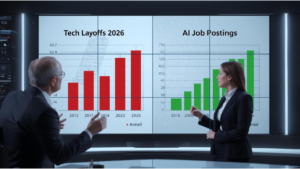
While layoffs spike in traditional corporate roles, job postings that mention AI skills are quietly increasing. Reporting from labor analytics researchers shows that listings referencing artificial intelligence competencies are rising, even as overall hiring slows.
According to hiring data discussed by CNBC, AI-related positions remain one of the few bright spots in a cooling job market.
This creates a paradox.
Companies are cutting roles — but still investing in automation and AI infrastructure.

The Corporate Calculation
Why would companies cut staff while increasing AI-related hiring?
The answer lies in efficiency.
Economic growth remains positive but slower than prior years. Interest rates remain elevated compared to the pandemic era. Corporate earnings calls increasingly emphasize productivity, cost control, and operational speed.
Coverage from Bloomberg highlights that executives are prioritizing leaner operations supported by automation tools rather than expanding payroll aggressively.
AI, in this context, is not a headline innovation.
It is an operational lever.
Tasks such as customer support triage, document review, internal reporting, and data analysis are being streamlined. That does not eliminate every job — but it reshapes team composition.
Companies are replacing certain repetitive functions with AI tools, while hiring specialists to implement, manage, and optimize those systems.

What This Means for Workers
The current labor environment reflects transition, not collapse.
Reports from Reuters indicate that while layoffs are concentrated in certain sectors, overall unemployment remains historically moderate. The issue is not an absence of work — but a reallocation of demand.
Workers in traditional operations roles face greater exposure to restructuring.
Workers with AI fluency — even basic proficiency — are increasingly positioned as enablers of transformation rather than casualties of it.
This shift does not require everyone to become a machine learning engineer.
It does require understanding how AI tools integrate into workflow.
Practical AI Solutions in a Cooling Market
For professionals navigating 2026’s uncertain hiring environment, the strategic response is not panic — it is adaptation.
1. Learn AI Workflow Integration
Understanding how AI tools streamline reporting, marketing, customer engagement, or logistics increases resilience in nearly every field.
2. Move Toward Oversight Roles
AI handles execution faster. Humans increasingly handle judgment, strategy, compliance, and creative direction.
3. Demonstrate AI Efficiency Gains
Employees who can show how AI reduced costs or saved time within teams become assets during restructuring decisions.
The data suggests that AI is not removing opportunity — it is redistributing it.
The Bigger Picture
Tech layoffs generate headlines. AI job growth generates footnotes.
But together, they reveal the direction of travel.
The American labor market in 2026 is not shrinking dramatically. It is reorganizing around automation and efficiency. And that reorganization rewards workers who align themselves with emerging demand.
The companies cutting jobs today are often the same companies expanding AI initiatives tomorrow.
The question for workers is simple:
Will you be on the automation side or the automated side?
FAQ
Are tech layoffs entirely caused by AI?
No. Broader economic conditions, restructuring, and post-pandemic over-hiring play significant roles.
Is AI hiring enough to offset layoffs?
Not entirely, but AI-related roles are growing even as other categories shrink.
What industries show resilience?
Healthcare services, AI implementation, cybersecurity, and advanced data analytics remain comparatively strong.