
Layoffs hit recession era in 2026, one of the most consequential early-year job figures in nearly two decades, with U.S. employers announcing 108,435 layoffs — the highest for a January since 2009 according to data from outplacement firm Challenger, Gray & Christmas. Major cuts spanned sectors including transportation, technology, and healthcare, reflecting growing corporate caution amid economic headwinds.
The layoff surge comes amid broader signs of labor market softness. Job openings fell to approximately 6.5 million in December 2025, the lowest level since 2020 — even as major employers added new roles in some areas.
But a closer look at the data suggests a complex labor market that isn’t simply contracting — it’s rebalancing, with artificial intelligence emerging as both a driver of change and a source of new opportunity.
Layoffs hit recession era in 2026 Vs AI Job surege
Despite the headline number of job cuts, January 2026 also saw a notable rise in overall employment growth. In the official Bureau of Labor Statistics (BLS) January jobs report, nonfarm payrolls increased by 130,000 — exceeding economists’ expectations and pushing the unemployment rate down to 4.3 %.
Those figures show a labor market that is not collapsing, but rather redistributing employment activity:
-
Large layoff batches in traditional operational roles
-
Job openings declining, signaling employer caution
-
Steady job growth overall, especially in services such as healthcare, social assistance, and construction
-
Revisions to past data showing weaker overall job growth in 2025 than previously reported from 584,000 down to 181,000 — marking the slowest pace since the early 2000s.
This paradox layoffs rising while hiring continues suggests that employers are optimizing staffing and reallocating investment toward areas seen as future growth engines.
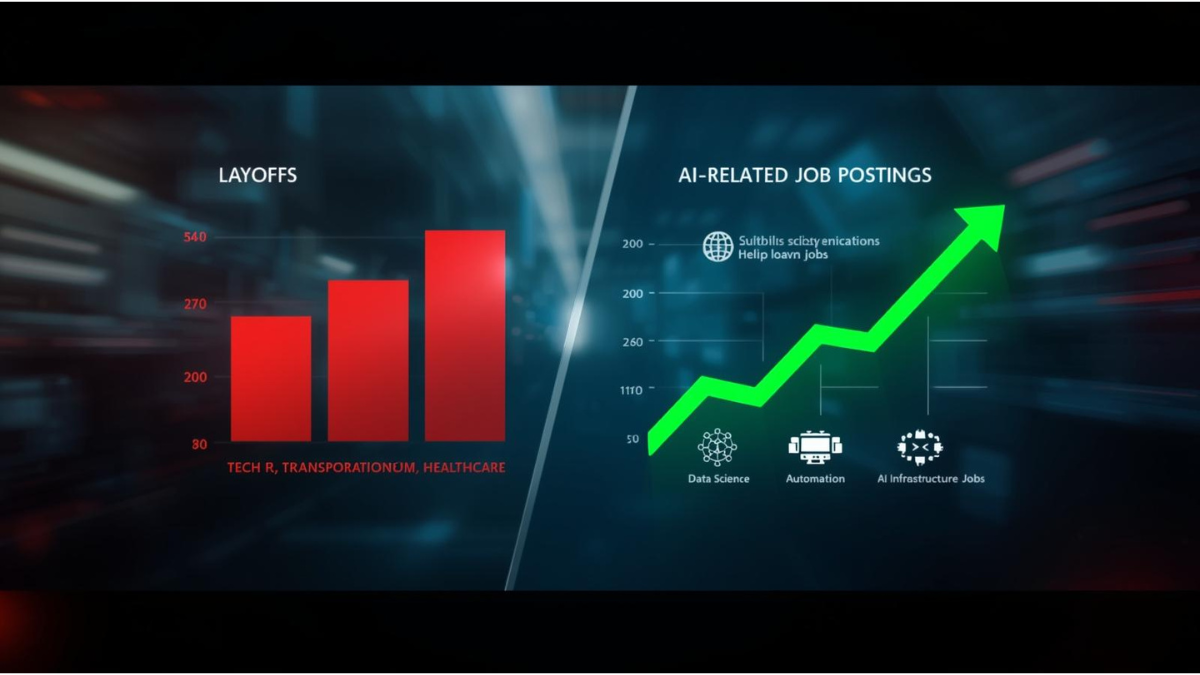
Infographic AI generated.
How AI Fits Into the Job Market Picture
AI was explicitly cited as a reason for a portion of the layoffs — approximately 7% of January cuts — but the full story runs deeper than simple cause and effect.
Economists caution that layoffs reflect combined pressures: cost optimization, contract losses, restructuring, and automation. AI is part of the narrative, but not the sole driver. In many cases, companies seeking to streamline workflow also hire specialists to develop, manage, and scale the very automation systems influencing broader staffing decisions.
At the same time, job postings that reference AI skills and competencies continue to rise — an indication that demand for talent in automation, machine learning, and AI implementation remains strong even in a sluggish labor market.
What This Means for Workers
The current labor landscape is a story of adjustment and transition rather than simple contraction:
📌 1. Some roles are shrinking
Operational and repetitive tasks — particularly where automation can reduce manual effort — are more likely to be restructured or eliminated.
📌 2. New opportunities emerge at the intersection of tech and business
Even as layoffs hit certain sectors, demand grows for professionals who can implement AI systems, analyze automation results, and ensure strategic integration.
📌 3. AI skills aren’t just “nice to have”
Resumes that include AI literacy — even at a basic level — are attracting attention from recruiters and hiring managers, especially in analytics, product management, and technical oversight functions.
Experts describe this as a rebalance rather than replacement: jobs are reorganized around technology, but new and evolving roles continue to be created. Analysts point out that the labor market’s slow growth reflects deeper demographic and economic forces — including slower labor force expansion and policy uncertainty — alongside technological change.

Navigating the Shift: Practical Insights
For U.S. professionals watching these trends unfold, the January data underscores several strategic considerations:
🔹 Reskill or Upskill
Invest time in acquiring core AI competencies — from data interpretation to practical tool workflows — to boost employability.
🔹 Leverage Cross-Functional Skills
AI fluency combines well with project management, domain expertise, and strategic problem solving — areas where human judgment remains essential.
🔹 Stay Informed on Labor Data
Understanding broad trends helps individuals anticipate structural shifts and plan longer-term career moves.
As the labor market continues adapting, workers who embrace change — rather than resist it — position themselves to take advantage of the new landscape.
FAQ
Are layoffs primarily caused by AI?
AI contributed to some job cuts, but economic restructuring and efficiency optimization remain primary drivers.
Is overall hiring still happening?
Yes — U.S. employers added 130,000 jobs in January, exceeding expectations and keeping overall unemployment modest.
What jobs are still growing?
Healthcare, social assistance, construction, and AI-related technical positions show relative strength.